 Ask ten furniture makers what the best finish for a dining table is and you'll get at least five different answers. Everyone has an opinion, and some of them are genuinely strong opinions.
The truth is that there isn't one universally best finish — there are several good options, each with different trade-offs. Here's a plain-English breakdown of what's available, what each one is good for, and what we use at Luke's Furniture Company and why.
The two categories of finish
All wood finishes fall into one of two broad categories: film-forming finishes and penetrating finishes.
Film-forming finishes sit on top of the wood and create a protective layer. Think of a thin skin of plastic or resin over the surface. Lacquer, polyurethane, and varnish are all film-forming finishes.
Penetrating finishes soak into the wood fibers and cure within the wood itself. They don't sit on top — they become part of the wood. Oils, hard wax oils, and Danish oil are penetrating finishes.
Both have their place. Here's how they compare for a dining table specifically.
Lacquer
Lacquer is one of the most common professional furniture finishes. It dries fast, buffs to a beautiful sheen, and provides good protection against everyday use. It's the finish used in most furniture factories.
The trade-off: lacquer can be chipped or scratched, and when it fails it tends to fail visually — peeling or chipping rather than wearing gracefully. Spot repairs are possible but can be tricky to blend invisibly.
Polyurethane
Polyurethane is the finish most homeowners know because it's available at every hardware store. It's extremely durable and provides good moisture resistance. It's also the finish most often associated with that "plasticky" look that people complain about in cheap furniture — because when applied poorly or in too many coats, it does look like plastic. A professional furniture craftsman can apply it in a way that maintains the natural beauty of the wood.
Applied professionally — sanded between coats, applied in controlled conditions — polyurethane can look beautiful. It's a legitimate option for a working dining table, especially if moisture resistance and maximum durability is a priority.
Hard wax oil
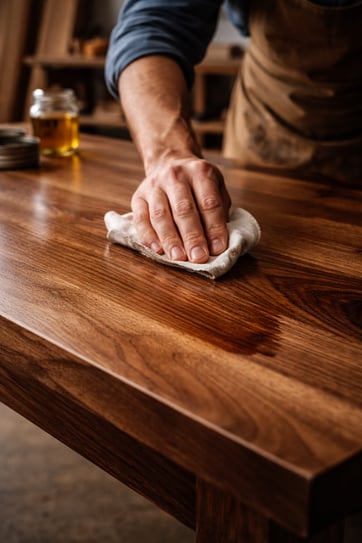
Hard wax oil (brands like Rubio Monocoat, Osmo, and Pallmann are popular) has become one of the most sought-after finishes in custom furniture in recent years. It penetrates the wood, enhances the natural color and grain beautifully, and leaves a low-sheen, natural-looking surface that's far removed from the plastic look of polyurethane.
The trade-off: hard wax oil requires more maintenance than a film finish. Spills need to be wiped up promptly. The finish will need periodic reapplication (typically every year or two, depending on use). But when something does happen to the surface, repair is simple — you just reapply the oil to the affected area.
For buyers who love the look of natural wood and don't mind the maintenance, hard wax oil is an excellent choice.
Which finish is right for you?
If your household is active — young children, frequent entertaining, people who don't always use coasters — a catalyzed lacquer or professional polyurethane gives you the most protection with the least maintenance.
If you value the natural look and feel of wood above all else, and you're willing to maintain it: hard wax oil.
If you want something in between: there are excellent hybrid finishes that offer better durability than pure oil with a more natural look than lacquer.
The honest answer is that a quality finish applied correctly matters more than which specific finish you choose. We're happy to talk through the options and make a recommendation based on how you actually use your table.
What We Use at Luke’s Furniture Company
Choosing the right finish is just as important as selecting the wood itself. At Luke’s Furniture Company, every piece is protected with a carefully selected, non-toxic finish designed to enhance the natural beauty of the wood while standing up to real everyday use. We offer three primary finish options, each tailored to different needs and lifestyles.
LFC Classic Finish
Our standard finish is a urenthane blend and provides a clean, low-sheen look that highlights the natural grain without adding unnecessary gloss. It offers reliable protection for everyday use while maintaining a soft, furniture-grade appearance. This is a great choice for clients who want a timeless look with solid durability.
Performance Finish
This is our most popular and durable option and the one we recommend for most dining tables. Built for real life, the Performance Finish is a 2k urethane finish highly resistant to water rings, spills, and daily wear. It allows you to use your table without worrying about coasters or constant upkeep—simply wipe clean with a damp cloth. Ideal for busy households, entertaining, and long-term durability.
Hand-Rubbed Finish
Our most natural and traditional option, the Hand-Rubbed Finish an oil/wax blend that is applied by hand to create a warm, organic look that brings out the depth and character of the wood. While it offers less protection than our Performance Finish, it is easy to maintain and repair over time, making it a great choice for those who value authenticity and a more tactile, natural feel.
Each finish is selected with intention, ensuring your piece not only looks exceptional on day one, but continues to perform beautifully for years to come.
Ready to get started?
Ready to see what a table built specifically for your home looks like? Tell us about your space and we'll put together a quote — no pressure, no obligation.